
written by Engage Studio
Engagement ring finger: Tradition, choice, and what works for you
Published July 7, 2026
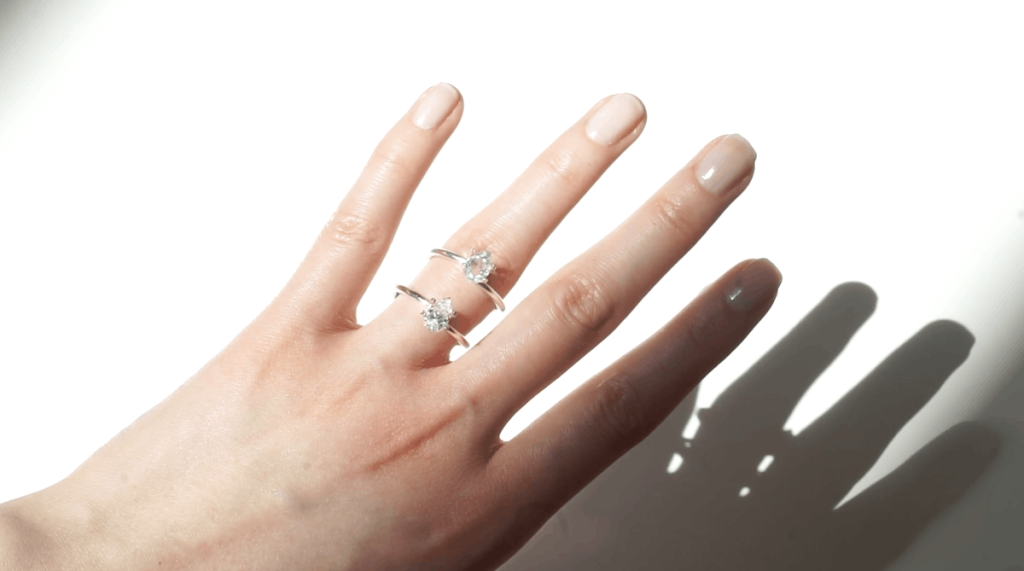
In Canada, the usual answer is the fourth finger of the left hand. That’s the finger most people mean when they talk about the engagement ring finger.
But that’s only the short answer.
The better answer is more personal. Your ring has to fit your hand, your culture, your work, and the way you actually want to wear it. Tradition can be lovely. It can also be flexible.
We meet a lot of people who ask this quietly, almost like they’re worried they’ve already done something wrong. They haven’t. Some wear the ring on the left hand. Some wear it on the right. Some only wear it outside the house. Some want a full stack after the wedding, while others know two rings on one finger will drive them mad.
All of it is fine.
Key takeaways
- In Canada, the engagement ring is traditionally worn on the fourth finger of the left hand.
- That tradition is a custom, not a rule.
- Before the wedding, many people wear it on the left ring finger.
- After marriage, you can stack both rings, wear them separately, or wear one ring day to day.
- Men’s engagement rings usually follow the same tradition, though couples often make their own choice.
- A ring should feel secure, comfortable, and realistic for your lifestyle.
Tradition vs. choice: the engagement ring finger explained
When someone asks which finger an engagement ring goes on, they’re usually looking for a simple answer. In Canada and many Western countries, the engagement ring goes on the left hand, fourth finger.
Then there’s the real-life answer, which is more forgiving.
You might have heard the Vena Amoris story, the old idea that the left ring finger had a vein running directly to the heart. It’s romantic, even if it’s not exactly how anatomy works. Still, stories like that are part of why this finger feels meaningful to many people.
We like tradition when it adds history to a ring. It just doesn’t need to make your choice feel smaller.
The Canadian custom and how it shapes expectations
If you’re in Toronto or elsewhere in Canada, the engagement ring finger most people recognize is the left hand, fourth finger.
This is also why many proposal rings are sized for that finger first. If someone asks us which finger is the engagement ring finger, that’s usually where we start.
But Canada is not one single tradition. Couples bring different cultures, families, religions, and preferences into the decision. One partner may expect the left hand. Another may come from a family where the right hand makes more sense.
That doesn’t make the choice confusing. It just makes it yours.
Not sure where to start?
Every custom ring at Engage Studio starts with a conversation, not a catalogue. Come talk it through with our team.
Contact UsWhere does the engagement ring go before the wedding?
Before the wedding, the most common answer is the left ring finger.
This applies whether you’re asking about the engagement ring finger for female wearers, the engagement ring finger for male wearers, or both partners wearing engagement rings. The tradition is often the same. The ring itself can look completely different.
Some people want a classic solitaire. Some want a lower setting because they’re hard on their hands. Some prefer a thicker band, coloured stone, or something quieter. If you’re comparing profiles, our guide to engagement ring setting styles breaks down the main options.
What happens to the ring on the wedding day?
The wedding day is where people suddenly wonder about the engagement ring finger vs. wedding ring finger.
Usually, the wedding band is placed on the same finger as the engagement ring. Tradition says the wedding band goes on first, closest to the heart, then the engagement ring sits above it.
To make that easier, some people move the engagement ring to the right hand before the ceremony, then move it back to the left hand after. Others let the ceremony happen, then fix the order later. That’s completely fine too.
After marriage: stacking, moving, or wearing them separately
After the wedding, many people wear both rings together. Wedding band first, engagement ring above it. It’s classic, especially when the two rings are designed to sit well together.
But not every set stacks neatly. Some engagement rings need a curved or contoured wedding band. Some leave a gap. Some people like that gap. Others notice it every time they look down.
Separate wear is normal too. You might wear your wedding band every day and save your engagement ring for weekends, dinners, or travel. None of that makes the ring less meaningful.
Men’s engagement rings: which finger and which hand?
Men’s engagement rings are becoming more common. For the men’s engagement ring finger, the traditional Canadian answer is still the fourth finger of the left hand.
That said, men’s rings often have a different feel. We see wider bands, matte finishes, signet-inspired shapes, brushed metal, black diamonds, engraving, and mixed metals. Some men use the engagement ring as their wedding band later.
A men’s engagement ring finger choice doesn’t need to copy anyone else’s. It just needs to feel comfortable and intentional.
Cultural variations are more common than people think
The left hand may be familiar in Canada, but it is not universal.
In some European traditions, rings are worn on the right hand. In some Indian, Chinese, and other cultural contexts, the hand or finger may depend on region, religion, family custom, or personal interpretation.
So when someone asks which hand and finger for an engagement ring, the most honest answer is: it depends. Some couples follow Canadian custom. Some follow family tradition. Some blend both. There is no need to force a choice that doesn’t feel like you.
Comfort, lifestyle, and ring sizing
A ring is emotional, of course. But it’s also a small object you may wear every day for years.
If you work with your hands, use gloves, lift weights, cook often, garden, work in healthcare, or travel frequently, daily wear may need some thought. Some people should not wear their engagement ring during certain tasks. That is not careless. It is often the best way to protect the ring.
Metal choice also affects how the ring feels and wears over time. Some metals show scratches more quickly, feel heavier, or change the overall look. Our guide on how to choose your engagement ring metal can help if you’re comparing options.
A ring should slide over the knuckle with a bit of resistance, then sit securely at the base of the finger. It should not pinch, leave a deep mark, spin constantly, or feel like it could slip off when your hands are cold.
Finger size changes with heat, cold, salt, exercise, travel, hormones, and even the time of day. When we size a ring, we look at the whole hand, not just the number.
Left hand or right hand: you are allowed to choose
If you came here wondering about the engagement ring finger because the traditional answer does not feel right, that’s okay.
You can wear your ring on your right hand. You can switch hands. You can wear it on a chain for work. You can move it because of swelling, arthritis, comfort, or knuckle shape. You can wear your wedding band daily and your engagement ring only sometimes.
People may notice the traditional placement first, but the meaning of the ring belongs to you.
Need help choosing the right fit?
If you’re thinking through sizing, placement, stacking, or what style will actually feel good on your hand, it helps to see the options in context. At Engage Studio, we size rings every day and help clients compare what works for their hands and lifestyle. You can start through our custom engagement ring process in Toronto or virtually.
Frequently Asked Questions
Which finger is an engagement ring worn on?
In Canada, an engagement ring is usually worn on the fourth finger of the left hand. That is traditional, but right-hand wear and other personal choices are common too.
What finger do you put the engagement ring on?
Most people put the engagement ring on the left ring finger before the wedding. Another finger or hand is fine if it suits you better.
Can I wear my engagement ring on my right hand?
Yes. Many people wear an engagement ring on the right hand for cultural reasons, work, comfort, or personal style.
What finger do men wear their engagement ring on?
Men often wear an engagement ring on the fourth finger of the left hand if they are following Canadian tradition. Some use it as their wedding band later.
What is the difference between engagement ring finger and wedding ring finger?
They are often the same finger. Many people wear both rings on the fourth finger of the left hand, with the wedding band closest to the hand and the engagement ring above it.
Is it okay not to wear my engagement ring every day?
Yes. Some people take their ring off for work, workouts, dishes, travel, or anything that might damage it. That is a sensible way to protect the ring, not a reflection of how much it means.